Two Different Problems, Often Confused
At our vein clinic in Hamilton, NJ, one of the most common questions we hear is: "Are these spider veins or varicose veins?" The two conditions look similar and often appear together, but they are distinct in their underlying cause, their medical significance, and the treatments that work best for each.
What Are Spider Veins?
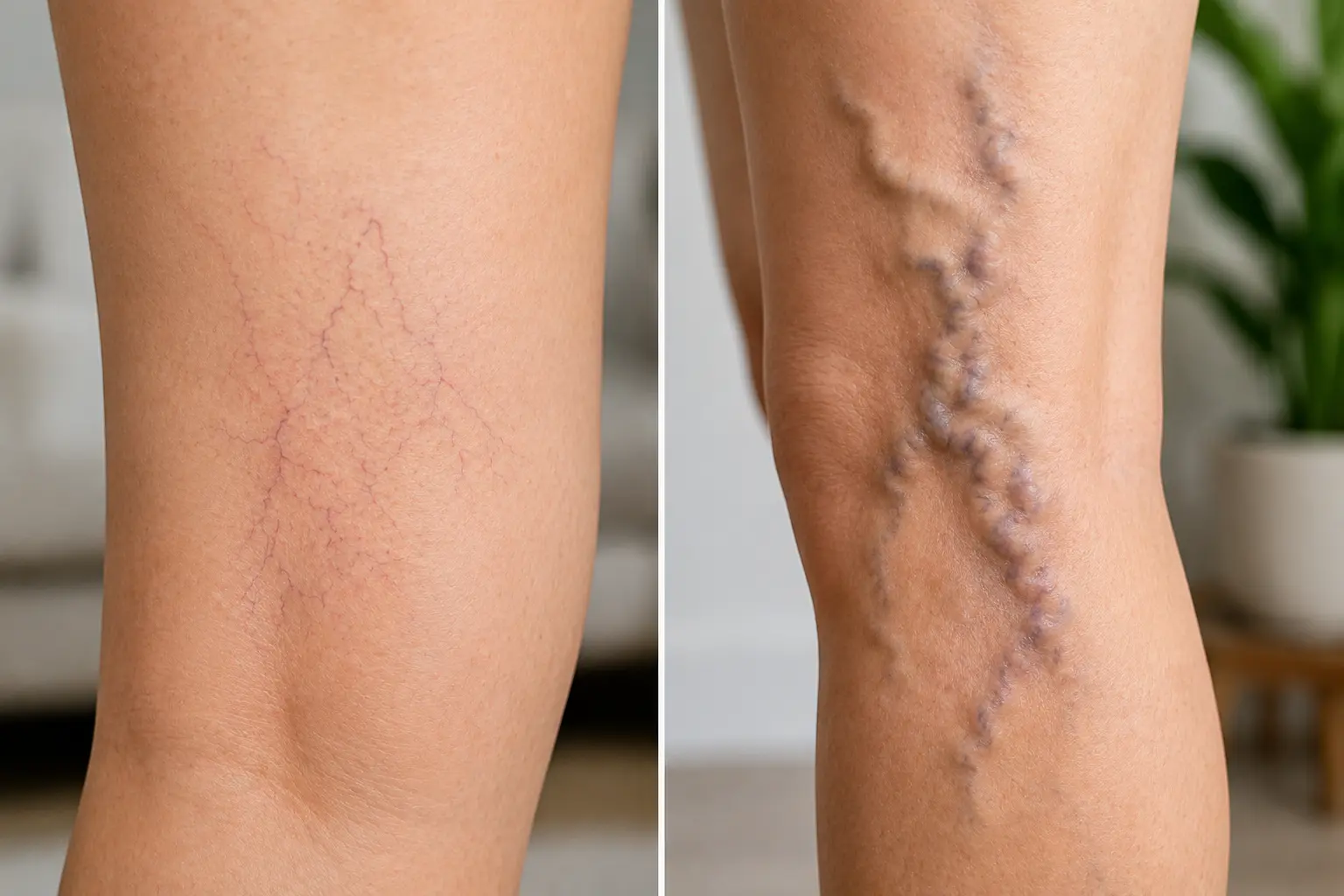
Spider veins (medically called telangiectasias) are tiny dilated blood vessels — usually less than 1 millimeter in diameter — that appear just beneath the skin surface as a web or starburst pattern. They can be red, blue, or purple and are most commonly found on the thighs, calves, and ankles, though they also appear on the face.
Spider veins are caused by increased pressure in the small superficial venules, hormonal changes, sun damage, or heredity. In the legs they are frequently a downstream symptom of deeper venous insufficiency — the same backward blood flow that causes varicose veins — but they are not always. On the face, broken capillaries and sun exposure are more often the cause.
Are spider veins medically dangerous? In most cases, no. They rarely cause significant symptoms beyond occasional mild itching or burning, and they do not progress to blood clots or ulcers. However, when they are extensive and cover large areas of the legs, they can signal underlying CVI that warrants a proper venous ultrasound evaluation.
What Are Varicose Veins?
Varicose veins are much larger — typically 3 millimeters or more in diameter — and they are actually bulging beneath the skin surface rather than just visible through it. They appear rope-like, twisted, or cord-like and are most common on the inner thigh, back of the calf, and behind the knee.
Varicose veins are caused by a specific failure: the one-way valves inside the great or small saphenous vein stop working, allowing blood to fall back down with gravity (called reflux). This creates elevated pressure throughout the superficial venous system, dilating the smaller branches into the twisted bulges you can see and feel.
Unlike spider veins, varicose veins frequently cause symptoms: aching, heaviness, throbbing, nighttime leg cramps, restless legs, and ankle swelling. They can also progress over years to stasis dermatitis, venous ulcers, and in some cases blood clots.
Side-by-Side Comparison
| Feature | Spider Veins | Varicose Veins |
|---|
| Size | Under 1 mm (flat) | 3 mm or more (bulging) |
| Appearance | Web, starburst, or lines | Rope-like, twisted, raised |
| Color | Red, blue, or purple | Blue, green, or skin-colored bulge |
| Symptoms | Usually none; occasional itch | Aching, heaviness, swelling, cramps |
| Medical risk | Low | Moderate to significant if untreated |
| Insurance coverage | Usually not covered (cosmetic) | Often covered when symptomatic |
| Best treatment | Sclerotherapy, laser | RFA, EVLT, VenaSeal, phlebectomy |
Can You Have Both?
Yes — and it is common. Varicose vein disease creates elevated pressure throughout the superficial venous system, which in turn causes spider veins to develop downstream. When both are present, treatment protocol matters: you must treat the underlying saphenous reflux first. If you inject spider veins without fixing the root-cause pressure, they often recur within months. This is why every patient at our Hamilton, NJ clinic starts with a duplex ultrasound rather than jumping straight to cosmetic treatment.
Treatment Options in NJ
For spider veins, sclerotherapy remains the gold standard — a simple in-office injection that causes the veins to fade over four to six weeks. Cryo-sclerotherapy (cooling the skin during injection) enhances comfort.
For varicose veins, the approach depends on the ultrasound findings. Most patients are candidates for one of three minimally invasive procedures done in our Hamilton office in under an hour: Radiofrequency Ablation (RFA), Endovenous Laser Therapy (EVLT), or VenaSeal. Larger surface bulges may be removed with ambulatory microphlebectomy.
Get a Definitive Diagnosis in Hamilton, NJ
Do not guess which type of vein problem you have. A 30-minute duplex ultrasound at Vein Treatment Centers of NJ will tell you exactly what is happening in your venous system and which treatment — or combination of treatments — is right for you. We serve patients from Hamilton, Trenton, Princeton, Freehold, and across New Jersey and Bucks County, PA. Call 609-585-4666 for a free screening.
Related Articles