
Best Treatment for Varicose Veins Without Surgery in NJ — A Complete Guide
Medically reviewed by Dr. Z. Hadaya, MD
Vein Treatment Centers of NJ
The End of Vein Stripping Surgery
If your parents or grandparents had varicose vein treatment, they may remember the old approach: general anesthesia, a hospital stay, painful recovery, and a long scar up the inner leg. That procedure — surgical vein stripping — has been effectively replaced by a suite of minimally invasive, non-surgical treatments that can be performed right in our Hamilton, NJ office in under an hour, with most patients returning to normal activities the same day.
Here is a comprehensive guide to the best non-surgical varicose vein treatments available in New Jersey today.
1. Radiofrequency Ablation (RFA) — The Gold Standard
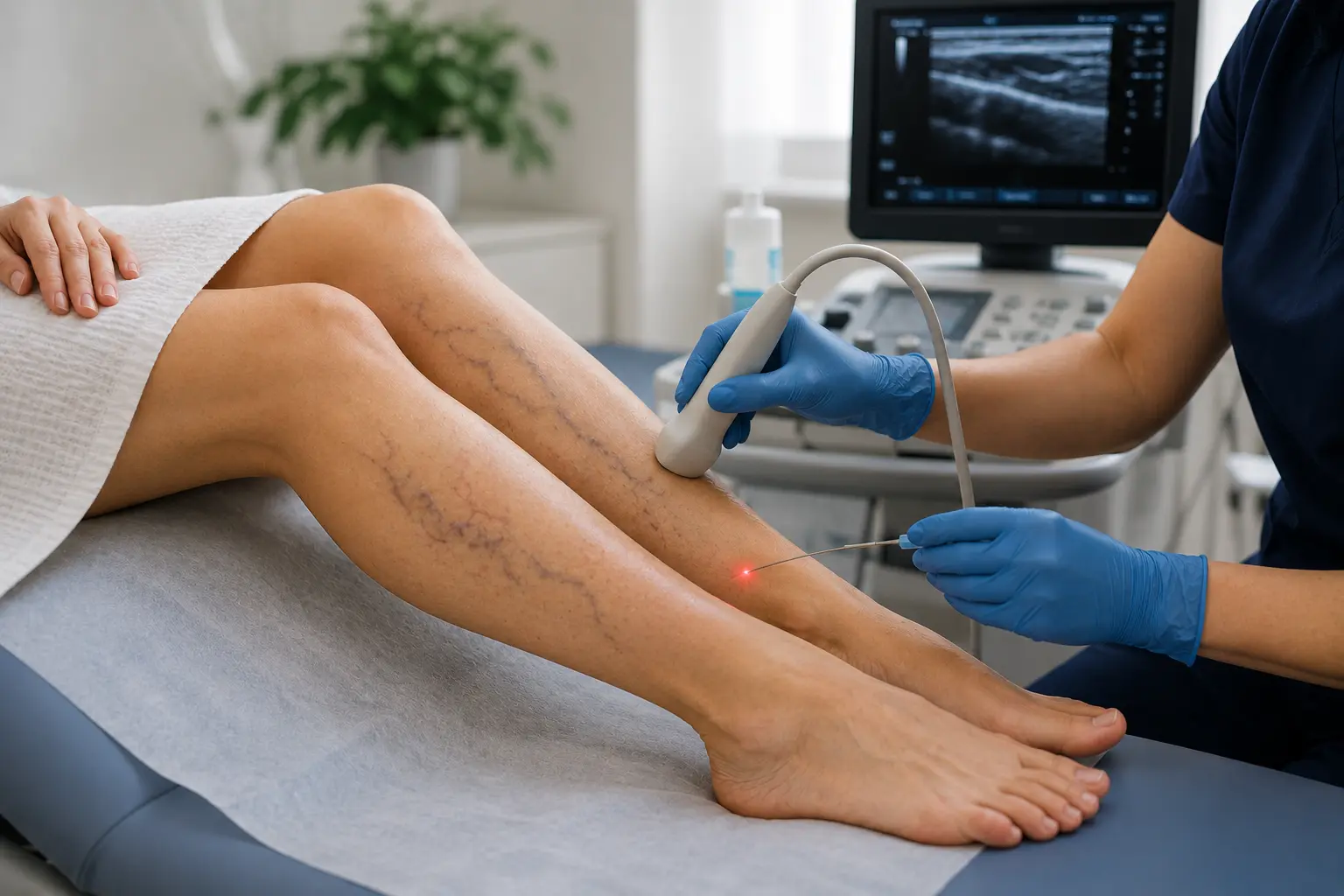
Radiofrequency ablation is the most widely performed treatment for varicose veins caused by saphenous vein reflux. A thin catheter is inserted into the diseased vein through a small nick in the skin about the size of a pencil point. Radiofrequency energy is delivered along the catheter, heating the vein wall to precisely 120°C and causing it to collapse and seal. Over the next few weeks, the body reabsorbs the sealed vein.
What to expect: The procedure takes 45–60 minutes. Local tumescent anesthesia numbs the leg so you feel no heat. You walk in, walk out, and resume light activity the same day. A compression stocking is worn for one to two weeks. Success rates exceed 95% at five years.
Insurance: RFA is covered by Medicare, Aetna, United Healthcare, Horizon BCBS, and most major insurers when venous reflux is documented on ultrasound and symptoms are present.
2. Endovenous Laser Therapy (EVLT)
Endovenous laser therapy works on the same principle as RFA — a catheter is inserted into the diseased vein and energy is applied to seal it — but uses laser energy instead of radiofrequency waves. Both procedures have comparable success rates and both are performed under local anesthesia in the office.
EVLT tends to produce slightly more post-procedure bruising than RFA in some patients, but results and long-term outcomes are equivalent. Dr. Hadaya selects the optimal approach based on the vein anatomy seen on your ultrasound.
3. VenaSeal — No Heat, No Compression Stockings
VenaSeal is the newest catheter-based treatment and the only one that uses a medical-grade adhesive (cyanoacrylate) to close the diseased vein rather than heat. A small amount of adhesive is delivered inside the vein at intervals as the catheter is slowly withdrawn, permanently bonding the vein walls together.
Key advantages of VenaSeal:
- No tumescent anesthesia injections (a more comfortable experience)
- No compression stockings required afterward
- Can be performed on both legs on the same day
- Immediate return to normal activities
VenaSeal is an excellent choice for patients who cannot tolerate compression stockings (e.g., those with peripheral arterial disease) or who have busy lifestyles that preclude post-procedure restrictions.
4. Ambulatory Microphlebectomy
Ambulatory microphlebectomy addresses the visible, bulging surface varicose veins that remain after the underlying saphenous reflux has been treated. Under local anesthesia, Dr. Hadaya makes a series of tiny incisions (1–2 mm, no stitches required) and removes the varicose vein segments with a small hook. The result is the complete removal of the visible vein — not just its closure — providing excellent cosmetic outcomes. You walk out the same day.
5. Sclerotherapy for Residual and Smaller Veins
Sclerotherapy involves injecting a chemical solution directly into the varicose or spider vein, causing it to inflame, scar, and fade. For small to medium varicose veins and spider veins, it is highly effective. For larger varicose veins caused by saphenous reflux, sclerotherapy is used as a follow-up treatment after the main reflux has been addressed with RFA, EVLT, or VenaSeal.
Ultrasound-guided sclerotherapy allows Dr. Hadaya to treat veins that are not visible on the skin surface but are identified on ultrasound imaging.
Which Treatment Is Right for You?
The honest answer: it depends on your ultrasound findings. There is no one-size-fits-all solution. Some patients need only sclerotherapy; others need RFA plus microphlebectomy plus sclerotherapy in a planned sequence. The treatment plan Dr. Hadaya creates after your duplex ultrasound is the only way to know for certain what will give you the best result.
Schedule Your Consultation at Our Hamilton, NJ Clinic
Vein Treatment Centers of NJ is located at 994 White Horse Avenue, Hamilton Township, NJ. We are conveniently accessible for patients from Trenton, Princeton, East Windsor, Lawrenceville, Ewing, and throughout Mercer County. Saturday morning hours are available. We accept most major insurance plans. Call 609-585-4666 or book online.
Related Articles
Ready to Address Your Vein Concerns?
Schedule a consultation with Dr. Hadaya to discuss your condition and explore treatment options.