
Vein Treatment in Princeton: Modern Care Options
Medically reviewed by Dr. Z. Hadaya, MD
Vein Treatment Centers of NJ
Seeking effective vein treatment in Princeton involves identifying the underlying cause of venous reflux rather than simply concealing surface blemishes. Modern outpatient care eliminates diseased veins using targeted thermal energy, medical adhesives, or precision micro-injections to redirect blood flow into healthy deep vessels. Most patients complete their diagnostic imaging and walk-in procedures in under an hour with zero hospital stays or extended downtime.
What Are the Primary Vein Conditions Treated Near Princeton?
Vein disorders range from minor cosmetic concerns to progressive circulatory diseases that impair mobility. When valves inside your leg veins weaken, blood struggles to move upward against gravity toward the heart. This failure causes retrograde flow, increased hydrostatic pressure, and blood pooling in the lower extremities.
Understanding Chronic Venous Insufficiency (CVI)
Chronic venous insufficiency develops when internal vein valves fail to close completely. Under normal conditions, tiny bicuspid valves open to allow blood to travel upward and snap shut to prevent backflow. When these leaflets stretch or degenerate, blood pools in the calf and ankle regions.
This pooling triggers an inflammatory cascade in surrounding tissues. If left unmanaged, chronic venous hypertension leads to recognizable clinical symptoms:
- Heaviness and fatigue: A persistent, weighted sensation in the calves that worsens after standing or sitting for prolonged periods.
- Aching and throbbing: Deep muscular discomfort along the inner thigh or calf that temporarily improves when legs are elevated above heart level.
- Edema: Fluid accumulation around the ankles and lower calves that intensifies toward the evening. You can learn more about managing fluid buildup in our guide to leg swelling treatment in New Jersey.
- Restless legs and nocturnal cramps: Involuntary leg twitching or sudden muscle contractions that disrupt sleep patterns.
- Stasis dermatitis and pigmentation: Reddish-brown staining (hemosiderin deposits) near the ankles caused by red blood cells leaking into subcutaneous tissue.
- Venous stasis ulcers: Shallow, slow-healing wounds near the medial malleolus (inner ankle bone) resulting from chronic skin breakdown and poor microcirculation.
Varicose Veins vs. Spider Veins
Patients frequently ask whether their visible leg veins are cosmetic or indicative of a deeper medical issue. While they share similar root causes, their anatomy and clinical impact differ significantly.
| Clinical Feature | Spider Veins (Telangiectasias) | Varicose Veins |
|---|---|---|
| Vessel Depth | Superficial intradermal layer | Subcutaneous fat layer |
| Physical Appearance | Fine red, blue, or purple web patterns | Raised, swollen, rope-like blue or green cords |
| Diameter | Typically under 1 millimeter | Typically 3 millimeters or larger |
| Underlying Cause | Localized capillary dilation or reticular feeder veins | Saphenous vein junction valve failure and reflux |
| Physical Symptoms | Primarily asymptomatic; occasional mild burning | Throbbing, localized aching, heaviness, skin changes |
| Standard Care | Visual or cryo-sclerotherapy | Thermal ablation, medical adhesive, or phlebectomy |
Bulging surface vessels are often the tip of the iceberg. Treating superficial branches without addressing the underlying saphenous trunks often causes symptoms and visible vessels to return rapidly.
Which Minimally Invasive Vein Procedures Are Available?
Outpatient vascular care has replaced traditional surgical vein stripping. Modern techniques rely on targeted micro-access methods performed under local anesthesia right in the office suite.
Thermal Ablation: RFA and EVLT
Thermal ablation therapies use controlled heat to close large, malfunctioning saphenous veins. These procedures treat the Great Saphenous Vein (GSV), Small Saphenous Vein (SSV), and major accessory branches.
- Radiofrequency Ablation (RFA): A thin catheter is inserted into the diseased vein through a needle puncture guided by continuous ultrasound. The catheter delivers calibrated radiofrequency energy in distinct segments, heating the collagen matrix within the vein wall. This causes the vessel to contract, collapse, and seal shut.
- Endovenous Laser Therapy (EVLT): A specialized radial laser fiber emits light energy at targeted wavelengths. The water within blood and endothelial tissue absorbs the laser energy, photothermally closing the vein.
Both techniques utilize tumescent anesthesia—a dilute mixture of saline, lidocaine, and sodium bicarbonate infused directly into the saphenous compartment surrounding the vein. This fluid buffer serves three essential functions: it numbs the treatment path, compresses the vein diameter around the heating element for uniform energy transfer, and protects adjacent skin, nerves, and soft tissues from thermal exposure.
Non-Thermal and Adhesive Solutions: VenaSeal and Sclerotherapy
For patients who prefer to avoid multiple numbing injections or who have contraindications to thermal energy, non-thermal modalities provide exceptional closure rates with minimal discomfort.
- VenaSeal Medical Adhesive: This approach delivers a specially formulated medical cyanoacrylate glue directly inside the diseased vein segment. Under precise ultrasound guidance, small drops of adhesive are placed along the vessel while the practitioner applies external compression. The glue polymerizes rapidly, permanently bonding the vein walls together. Because VenaSeal does not generate heat, it requires only a single local numbing injection at the entry site, and patients are not required to wear heavy post-procedure compression stockings.
- Ultrasound-Guided Foam Sclerotherapy: For tortuous, twisted branches beneath the skin surface that cannot accommodate a straight catheter, a sclerosant medication is agitated with gas to form a micro-foam. Under real-time ultrasound, the foam displaces trapped blood and contacts the endothelial lining directly, triggering chemical closure.
- Visual Sclerotherapy and Cryo-Sclerotherapy: For surface telangiectasias and reticular veins, liquid or cold-air-assisted sclerotherapy injects micro-doses of solution into fine vessels, prompting the body to gradually reabsorb them. Learn more about our targeted care for spider veins.
- Microphlebectomy: Protruding, ropey surface varicose veins that remain visible after trunk closure can be physically removed through micro-punctures as small as 1 to 2 millimeters. Performed under local anesthesia, microphlebectomy requires zero stitches, leaves minimal scarring, and produces immediate physical relief from bulky surface clusters.
What Happens During Your Initial Vein Evaluation and Diagnostic Ultrasound?
A thorough clinical assessment forms the foundation of durable vein care. Your first appointment focuses on mapping your venous architecture to pinpoint exactly where valves are failing.
Diagnostic Workflow
- Clinical History & Physical Exam
- Documenting symptom duration, heaviness, swelling, and prior conservative measures like compression.
- Duplex Ultrasound Mapping
- Standing/tilt-table assessment of GSV, SSV, and deep veins.
- Quantifying retrograde flow duration (reflux > 0.5s).
- Personalized Treatment Strategy
- Direct physician review of vein diameter, depth, and valve anatomy to select thermal, adhesive, or foam closure.
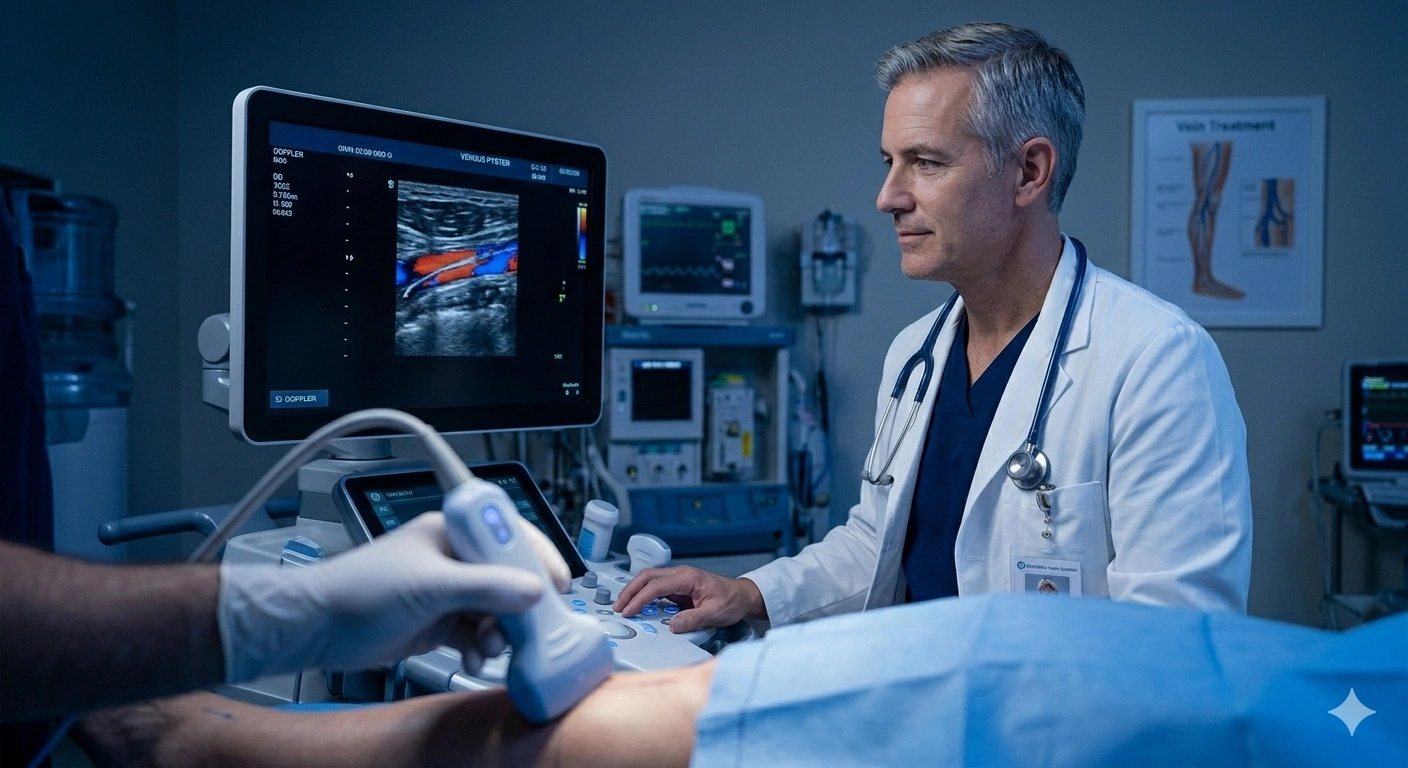
The gold standard diagnostic tool is a non-invasive duplex ultrasound. During this exam, you will stand on an elevated platform while the vascular technologist images your leg veins in both transverse (cross-sectional) and longitudinal views.
The sonographer applies manual calf compressions or pneumatic cuff releases to assess valve function. In a healthy vein, blood flows upward toward the heart, and the valve snaps closed within a fraction of a second. If reverse flow (reflux) persists for longer than standard diagnostic thresholds—typically greater than 500 milliseconds (0.5 seconds) in saphenous trunks—the valve is diagnosed as incompetent.
Following the scan, your treating vascular doctor reviews the anatomical map with you to correlate specific ultrasound findings with your physical symptoms. We explain which veins require closure, which are healthy, and the optimal sequence of procedures for your anatomy. You can learn more about this process by reviewing our ultrasound evaluation protocols.
Does Insurance Cover Vein Treatment in New Jersey?
Most major commercial insurance plans and Medicare provide coverage for vein care when it is performed to treat medically necessary chronic venous disease rather than purely cosmetic concerns.
To qualify for medical coverage, insurance carriers generally require documented clinical findings demonstrating that venous insufficiency impairs your daily functioning. Common coverage criteria include:
- Documented clinical symptoms: Persistent leg aching, throbbing, fatigue, or swelling that limits work or daily physical activities.
- Objective physical findings: Visible varicose veins measuring at least 3 millimeters in diameter, recurrent phlebitis, stasis dermatitis, bleeding from superficial veins, or active venous ulcers.
- Diagnostic duplex ultrasound proof: A recent ultrasound confirming anatomical reflux in the saphenous or tributary systems that meets the insurer's duration criteria.
- A completed trial of conservative therapy: Many private payers mandate a documented trial of conservative measures—typically wearing prescription-grade graduated compression stockings (20-30 mmHg), regular leg elevation, and exercise modifications—before approving procedural intervention.
Major regional and national insurance carriers operating in Mercer County—including Horizon Blue Cross Blue Shield of New Jersey, Medicare, Aetna, Cigna, and UnitedHealthcare—maintain distinct pre-authorization guidelines. For detailed steps on handling coverage requirements, read our guide on how providers help with vein treatment insurance verification.
How to Choose the Right Vein Specialist Near Princeton
Selecting a vascular specialist is the most critical factor in achieving safe, permanent relief from vein disease. Because vein care is an evolving field, clinical standards vary widely between practices.
When evaluating local providers, look for these key distinctions:
- Consistent single-doctor care: Many corporate vein chains assign rotating, per-diem providers to perform procedures, meaning the doctor who performs your consultation may not be the one performing your thermal ablation or post-procedure ultrasound. Choosing a practice with dedicated, continuous physician oversight ensures your doctor understands your full vascular history from initial mapping through full recovery.
- Intersocietal Accreditation Commission (IAC) standards: Reputable vein clinics operate vascular ultrasound suites accredited by the IAC, ensuring rigorous safety, equipment calibration, and sonographer credentialing.
- Comprehensive treatment modalities: Avoid clinics that only offer a single procedure type. A well-rounded practice offers thermal ablation, adhesive closure, foam sclerotherapy, and microphlebectomy to customize care to your specific vein anatomy. Learn more about what sets comprehensive practices apart on our why choose us page.
At The Vein Treatment Centers of New Jersey, we focus on individualized medical vein care and long-term circulatory health for patients throughout Mercer County.
Convenient geographic access matters when selecting a clinic. For residents in Princeton, traveling to our nearby Hamilton office on White Horse Avenue provides a direct route via Route 1 South and I-295, with hassle-free, dedicated on-site parking avoiding downtown congestion. If you are exploring comprehensive options across the region, you can also review our guide to varicose vein treatment near me.
Taking proactive steps toward medical vein treatment in Princeton protects your mobility, resolves daily leg discomfort, and halts the progression of venous disease before serious skin complications arise.
Frequently Asked Questions
How long is the recovery time after vein treatment?
Most patients resume normal walking immediately after the procedure and return to work and light daily activities the same day. Strenuous exercise, heavy weightlifting, and hot baths are typically avoided for three to seven days, depending on the specific technique used.
Are modern varicose vein treatments painful?
Outpatient vein procedures cause minimal discomfort because the treatment area is thoroughly numbed using local anesthetics. Non-thermal techniques like medical adhesive require only a single minor injection, while cooling devices and cryo-technology reduce skin sensitivity during surface injections.
Can treated varicose veins return after closure?
Once a diseased vein is sealed by thermal ablation, adhesive, or sclerotherapy, the body gradually absorbs the closed tissue, making recurrence in that specific vessel impossible. However, because venous disease is progressive, maintaining circulatory health, wearing compression during travel, and attending periodic follow-ups help prevent new, untreated veins from developing reflux.
How do Princeton residents access our nearby vein center?
Princeton residents can reach our Hamilton facility on White Horse Avenue in approximately fifteen to twenty minutes via Route 1 South and I-295 South. Our facility offers ground-floor access and dedicated patient parking for easy appointments. To schedule your initial consultation and vascular duplex ultrasound, please contact our clinical team today.
Ready to Address Your Vein Concerns?
Schedule a consultation with Dr. Hadaya to discuss your condition and explore treatment options.