
Sclerotherapy vs Laser for Spider Veins: Cost & Value
Medically reviewed by Dr. Z. Hadaya, MD
Vein Treatment Centers of NJ
When evaluating sclerotherapy vs laser for spider veins cost, sclerotherapy is typically the more economical and efficient choice for the legs because a single injection can clear an entire branching network of vessels. Surface laser therapy usually requires more passes and specialized equipment to treat broad surface areas, making it better suited for tiny, isolated vessels on the face or upper body. Your total financial investment depends heavily on the surface area treated, the number of clinical sessions required, and whether an underlying circulation issue is driving your spider veins.
Sclerotherapy vs Laser for Spider Veins Cost: Main Differences
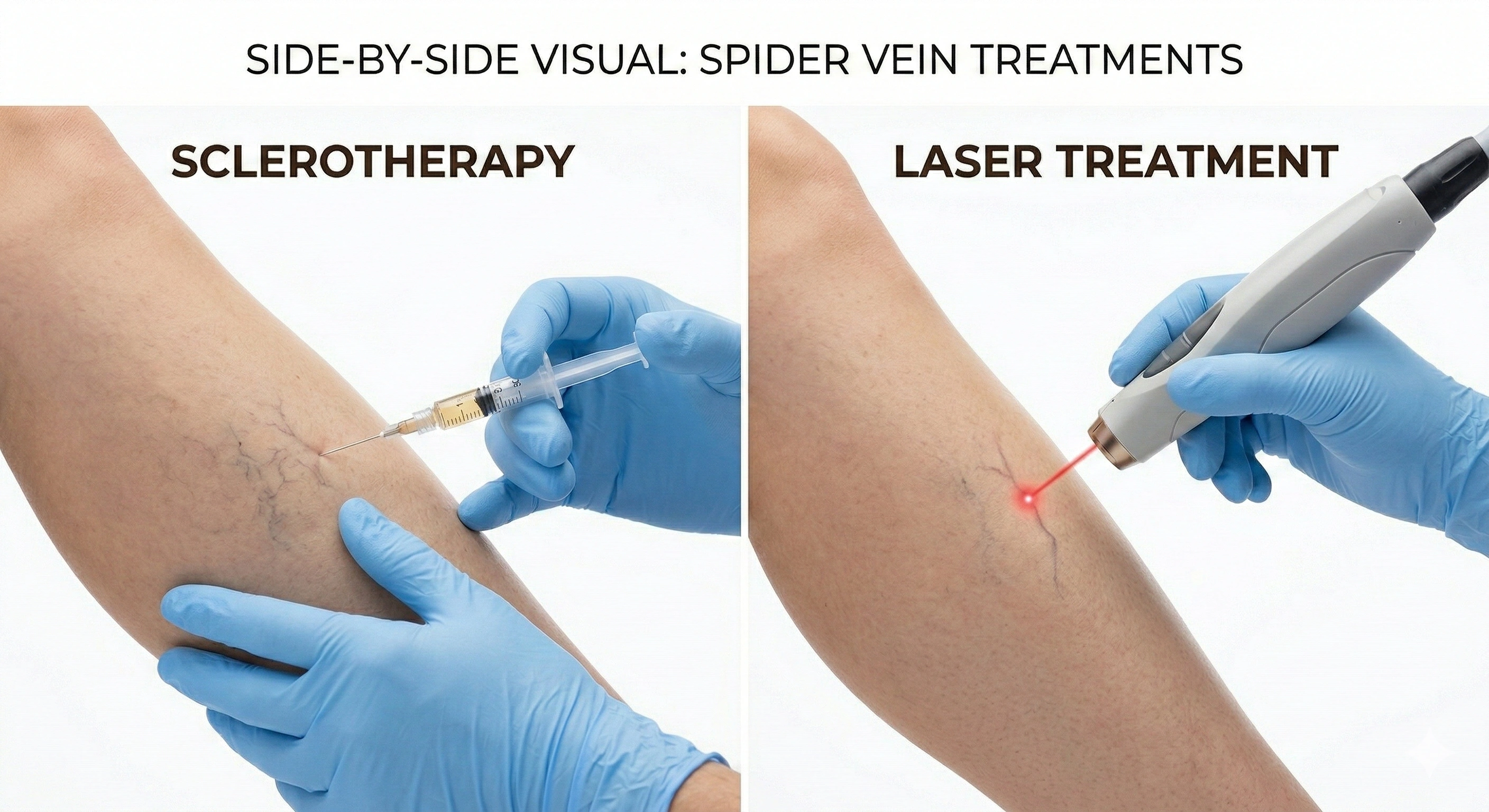
The fundamental financial difference between sclerotherapy and transdermal laser therapy stems from how each procedure delivers treatment to the damaged vein. Sclerotherapy uses a direct chemical agent injected into the vessel lumen, while laser therapy utilizes focused light energy directed through the skin surface.
Because liquid and foam sclerosants naturally disperse through interconnected vessel branches, a practitioner can often treat multiple spider veins with a single needle insertion. Transdermal laser therapy, by contrast, operates along a narrow beam that must trace the exact line of every individual capillary. Treating a wide cluster of leg veins with laser therapy demands significantly more time, pulses, and office visits, which drives up the cumulative procedural cost compared to injection therapy.
[Target Vessel Network] │ ├─► Sclerotherapy: Solution flows into connecting branches (broad coverage per injection) │ └─► Surface Laser: Beam traces each millimeter individually (precise, localized delivery)How Liquid and Foam Sclerotherapy Work
In a clinical setting, sclerotherapy begins with identifying the primary feeding vessels—often called reticular veins—that supply blood to visible surface spider veins. Using an ultra-fine needle, we inject a specialized sclerosant solution directly into the target vessel.
The medication displaces blood within the vein and irritates the inner endothelial lining. This controlled irritation causes the vessel walls to swell, adhere together, and collapse shut. Over several weeks, the body naturally breaks down the closed vessel through its normal metabolic processes, redirecting blood flow into deeper, healthy veins.
For very small, superficial spider veins, a liquid solution works cleanly without excess displacement. For slightly larger blue or green reticular veins, the solution can be agitated with air or physiological gas to create a microfoam. Foam expands within the vein, pushing blood out of the way to achieve maximum contact with the vein wall without requiring higher chemical concentrations.
How Surface Laser Vein Therapy Works
Surface laser therapy relies on the principle of selective photothermolysis. A handpiece delivers concentrated wavelengths of light directly through the outer layers of the skin, targeting the hemoglobin inside the red blood cells of the spider vein.
As hemoglobin absorbs the light energy, it converts that light into thermal energy. This sudden heat coagulates the blood and causes the thin vascular walls of the spider vein to collapse and seal. Unlike sclerotherapy, no needles puncture the skin, and no chemical agent enters the bloodstream.
However, because the light must pass through the epidermis to reach the vein, the practitioner must carefully calibrate the energy level to protect surrounding skin tissue. This makes surface laser an excellent option for delicate zones, though it requires multiple overlapping pulses to treat even a modest patch of leg veins.
Comparing Effectiveness, Comfort, and Treatment Areas
Selecting between sclerotherapy and laser therapy involves weighing the location of the veins, skin type, and physical comfort during recovery. For the lower extremities, sclerotherapy remains the primary clinical choice for both spider veins and underlying reticular veins. Leg veins are subject to higher hydrostatic pressure from gravity, and chemical closure provides a durable seal against that pressure.
Transdermal laser vein removal shines when treating facial veins, particularly around the nose, cheeks, and temples. The skin on the face is much thinner than on the legs, making facial capillaries exceptionally responsive to light energy. Additionally, performing liquid sclerotherapy in certain areas of the face carries higher vascular risks due to complex facial arterial pathways, making non-invasive lasers the preferred standard for facial telangiectasias.
Patients who experience severe needle aversion often lean toward laser treatment, though laser therapy is not sensation-free; patients frequently describe the pulses as feeling like a hot rubber band snapping against the skin.
Side effect profiles also differ between the two techniques:
- Sclerotherapy commonly causes minor localized bruising, temporary redness at injection sites, and occasional hemosiderin staining (a light brown pigmentation caused by iron deposits from trapped red blood cells, which gradually fades).
- Surface Laser Therapy can cause localized swelling, superficial skin redness (erythema), and temporary skin blistering or crusting if the skin absorbs excess thermal energy.
| Feature | Sclerotherapy | Transdermal Laser Therapy |
|---|---|---|
| Primary Target Area | Legs, thighs, ankles, and calves | Face, neck, chest, and fine residual leg veins |
| Ideal Vein Size | Small spider veins to medium reticular veins | Microscopic spider veins and fine telangiectasias |
| Coverage per Session | Broad; treats branch networks efficiently | Localized; traces individual vessels point-by-point |
| Treatment Sensation | Mild pinpricks with slight stinging | Snapping sensation with localized heat |
| Common Side Effects | Mild bruising, temporary hemosiderin staining | Redness, localized heat, potential blistering |
| Compression Wear | Recommended for several days post-treatment | Rarely required after facial or minor leg treatment |
Key Factors That Influence Total Spider Vein Removal Expenses
When planning for cosmetic vein care, several clinical variables dictate the ultimate financial outlay:
- Extent and Density of the Vein Clusters: A patient with isolated, faint spider veins on one calf requires far less clinical time and material than someone with dense, bilateral spider vein "bursts" stretching from the upper thigh to the ankle.
- Underlying Venous Insufficiency: Spider veins are frequently the visible symptom of deeper valve failure in the saphenous vein system. If deeper reflux exists, treating surface spider veins alone will lead to rapid recurrence. A diagnostic ultrasound evaluation helps map the venous architecture prior to treatment so that deeper issues are resolved first.
- Provider Credentials and Facility Setting: Treatment performed by dedicated vein specialists in an accredited medical practice offers thorough diagnostic oversight compared to generic medspas. At Vein Treatment Centers of NJ, our clinical team evaluates your vascular anatomy to determine whether surface veins stem from deeper reflux.
- Maintenance Requirements: Vein disease can be progressive. While treated vessels do not return, genetic predispositions and lifestyle factors mean new spider veins may form over the years, requiring occasional touch-up sessions.
Does Insurance Cover Sclerotherapy or Laser Spider Vein Care?
Health insurance carriers categorize isolated spider veins as a cosmetic concern. Consequently, purely aesthetic sclerotherapy or transdermal laser treatments performed solely to improve appearance are not covered by standard insurance policies.
Coverage changes, however, when spider veins are accompanied by documented medical symptoms caused by chronic venous disease. If a patient experiences chronic aching, leg heaviness, throbbing, skin changes, or localized bleeding, an insurance provider may authorize coverage for diagnostic duplex ultrasound and treatments targeting deeper venous reflux.
If diagnostic imaging reveals underlying valve failure in the saphenous veins, medical interventions for varicose veins or deeper reflux are routinely covered by major plans. Resolving this high-pressure reflux relieves the backpressure that feeds surface spider veins, making any subsequent cosmetic touch-ups far more durable and cost-effective. For more insight into related circulation issues, read our guide on leg swelling treatment in New Jersey.
Choosing the Best Procedure for Your Legs
Determining the right treatment approach starts with a careful diagnostic evaluation rather than choosing a procedure based on equipment preferences alone.
[Initial Consultation] │ ▼ [Duplex Ultrasound Mapping] │ ┌───────┴─────────────────────────┐ ▼ ▼ [Reflux Detected] [No Reflux / Purely Superficial] │ │ ├─► Treat Deeper Veins First ├─► Sclerotherapy (Legs & Reticulars) └─► Follow with Sclerotherapy └─► Laser Therapy (Face & Fine Matting)The clinical selection process follows clear anatomical rules:
- Vein Diameter and Depth: Vessels larger than a pinpoint needle that sit slightly below the epidermis respond best to liquid or foam sclerotherapy. Microscopic red capillaries flush with the skin surface—especially on the face—are ideal candidates for laser therapy.
- Addressing Feeder Pressures: If spider veins stem from a greenish reticular "feeder" vein, injecting that feeder vein collapses the entire branch network. Attempting to laser the surface branches without closing the feeder vein usually leads to treatment failure.
- Skin Pigmentation: Surface lasers require precise wavelength adjustments for darker skin tones to prevent melanin absorption and pigment changes. Sclerotherapy bypasses the skin surface entirely, making it safe across all skin complexions.
Before booking a procedure, ask your vein physician these practical questions:
- Will you perform a duplex ultrasound to check for deeper reflux before we begin surface treatments?
- How many total sessions do you anticipate my vein pattern will require?
- Do you recommend a hybrid approach using sclerotherapy for feeder veins and laser for fine surface vessels?
- What post-procedure protocol should I follow to minimize bruising and pigmentation?
To learn more about comprehensive vein management, explore our overview of varicose vein treatment near me.
Frequently Asked Questions
What is the cheapest way to get rid of spider veins?
For leg spider veins, sclerotherapy is almost always the most economical method. Because injected sclerosants flow through connected vascular branches, a specialist can treat a wide network of veins in a single appointment, reducing the total number of clinical visits required compared to surface laser therapy.
Does laser get rid of spider veins permanently?
Yes, spider veins that successfully collapse and are reabsorbed by the body after laser therapy are gone permanently. However, laser treatment does not alter your underlying genetics or relieve venous hypertension, which means new spider veins can develop in adjacent areas over time if predisposing factors remain.
Is sclerotherapy worth it for spider veins on the legs?
Sclerotherapy offers high clinical success rates for leg veins, providing noticeable visual clearing as well as physical relief from localized burning, itching, or aching. For patients seeking clear legs, it remains the gold standard because it effectively addresses both tiny capillaries and the deeper feeder veins that supply them.
Can sclerotherapy and laser treatments be combined?
Yes, clinicians frequently combine both modalities for comprehensive vascular rejuvenation. Sclerotherapy is utilized first to collapse deeper reticular and larger spider veins, followed by surface laser therapy to clear tiny residual red telangiectasias or delicate matting that is too small for a needle.
Ready to Address Your Vein Concerns?
Schedule a consultation with Dr. Hadaya to discuss your condition and explore treatment options.